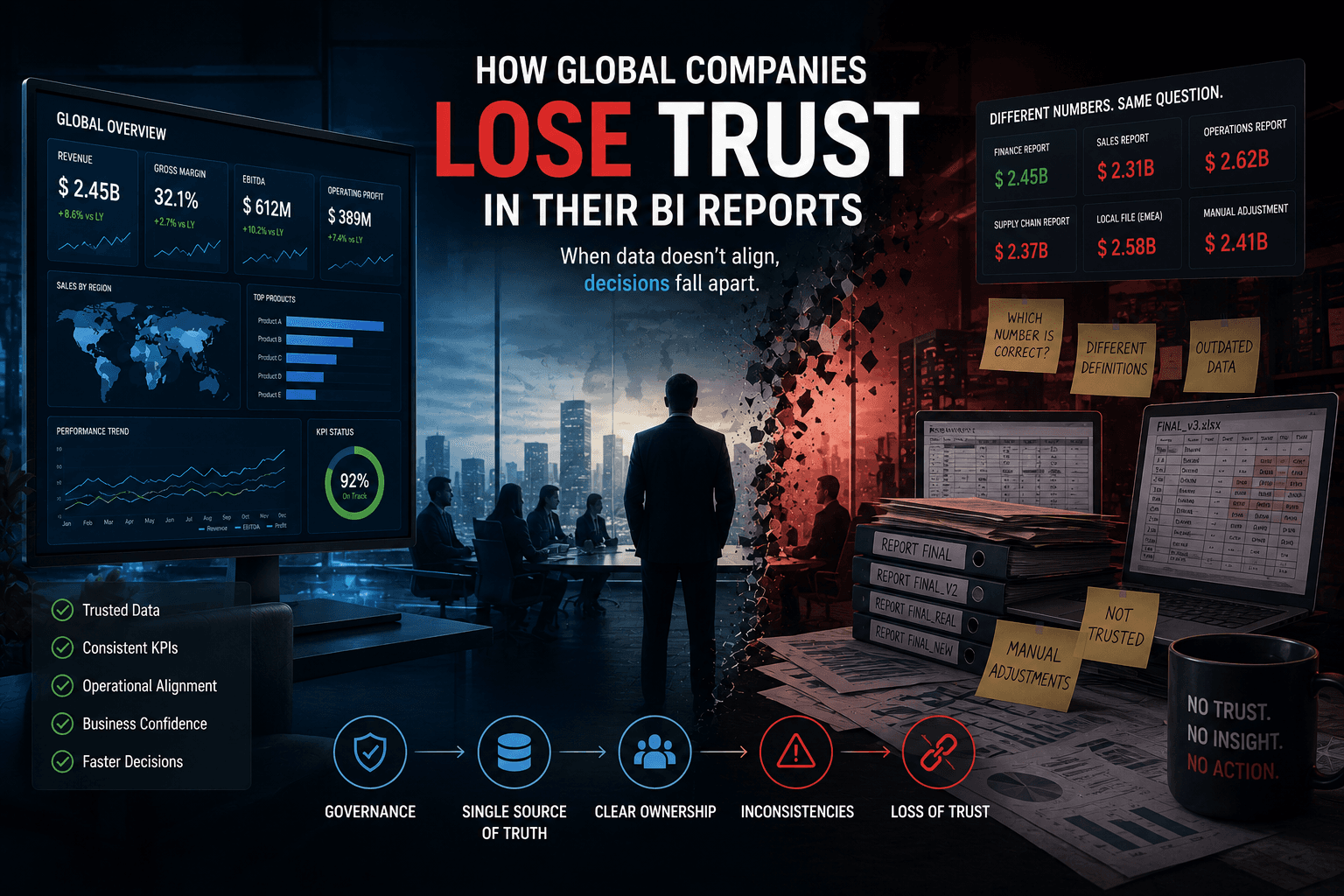
Why Companies Lose Trust in BI Reports
Most enterprise reporting problems do not appear suddenly.
Trust in BI systems usually disappears slowly.
At first: small inconsistencies emerge:
- a KPI mismatch
- a delayed refresh
- a dashboard that doesn’t match finance numbers
- a report differing from SAP
- a Power BI total that conflicts with Excel
Individually, these problems seem minor.
But over time: they accumulate.
Eventually: business users stop trusting the reporting environment entirely.
And once trust disappears, the entire value of the BI ecosystem collapses.
Because business intelligence is not only about dashboards.
It is about creating confidence in operational decision-making.
The Most Dangerous Reporting Problem Is Invisible
Most organizations monitor:
- infrastructure
- cybersecurity
- application performance
- cloud costs
- operational KPIs
But very few monitor: trust in reporting systems.
This is dangerous.
Because reporting distrust spreads quietly across organizations.
At first: teams still use dashboards.
Then: they begin double-checking numbers manually.
Later: they export data into Excel.
Finally: they stop relying on BI reports altogether.
At this stage, the BI platform technically exists — but operationally, it is no longer trusted.
Why Reporting Trust Matters So Much
Enterprise organizations make decisions based on:
- sales forecasts
- supply chain reporting
- finance KPIs
- operational metrics
- inventory visibility
- profitability analysis
When reporting trust disappears: decision-making slows dramatically.
Executives begin questioning:
- “Which number is correct?”
- “Which dashboard should we trust?”
- “Why does finance show something different?”
- “Can we validate this in Excel first?”
Instead of accelerating operations, reporting becomes a source of friction.
1. KPI Definitions Become Fragmented
This is one of the most common causes of reporting distrust.
Different teams interpret KPIs differently.
For example: “Net Sales” may mean:
- invoiced revenue
- shipped quantities
- accounting postings
- order bookings
- local entity adjustments
Over time: every department develops its own logic.
The organization starts operating with: multiple versions of reality.
Eventually: users stop trusting centralized dashboards.
2. Reporting Ecosystems Become Too Complex
Large enterprise environments often include:
- SAP
- Snowflake
- Power BI
- legacy systems
- Excel reporting
- local databases
- semantic layers
- ETL pipelines
Every additional layer introduces:
- transformations
- business rules
- data mappings
- refresh dependencies
Over time: the reporting ecosystem becomes difficult to govern consistently.
Complexity quietly erodes trust.
3. Operational Reality Changes Faster Than Dashboards
Organizations constantly evolve:
- new entities
- mergers
- acquisitions
- process changes
- new products
- changing operational workflows
But dashboards often remain static.
As business reality changes, reporting environments slowly become disconnected from operations.
Users begin hearing:
- “This report doesn’t reflect the current process.”
- “The dashboard is outdated.”
- “We still need manual corrections.”
Trust decreases progressively.
4. Data Quality Problems Multiply Over Time
Enterprise reporting environments are rarely perfectly clean.
Common issues include:
- duplicate records
- missing data
- inconsistent mappings
- delayed refreshes
- broken joins
- incorrect master data
Initially: teams compensate manually.
But eventually: users stop believing the numbers entirely.
At this stage: even accurate reports become questioned.
5. Too Many Local Reporting Workarounds Exist
This is extremely common in global organizations.
Business units often create:
- local Excel trackers
- offline reports
- manual KPI adjustments
- shadow reporting systems
Why?
Because centralized reporting:
- feels too slow
- lacks operational flexibility
- misses business context
- cannot adapt quickly enough
Over time: the organization loses reporting standardization completely.
The Psychological Collapse Of Reporting Trust
This is rarely discussed, but it is critical.
Once users stop trusting reports: they stop trusting dashboards emotionally.
The organization develops:
- skepticism
- reporting fatigue
- KPI confusion
- validation anxiety
Meetings become dominated by:
- reconciliation discussions instead of:
- operational decisions
At this stage, the reporting environment is no longer supporting the business.
It is slowing it down.
Why BI Modernization Projects Often Fail
Many BI transformation projects focus heavily on:
- visualization redesign
- dashboard quantity
- AI integrations
- cloud migration
- UX improvements
But ignore:
- governance
- KPI ownership
- operational workflows
- reporting alignment
- semantic consistency
Without trust: even the most advanced BI stack becomes ineffective.
The Hidden Operational Cost Of Distrusted Reporting
Most organizations underestimate the true impact.
Distrusted reporting environments create:
- duplicated work
- delayed decisions
- operational inefficiencies
- governance conflicts
- manual reconciliation processes
- reporting fatigue across teams
This silently reduces organizational agility.
What High-Trust Reporting Environments Do Differently
Organizations with strong reporting adoption prioritize:
1. KPI Governance
Shared business definitions across departments.
2. Semantic Consistency
Centralized analytical logic.
3. Operational Alignment
Reports connected to real workflows.
4. Controlled Transformations
Governed data pipelines and business rules.
5. Reporting Transparency
Clear understanding of how KPIs are calculated.
The Future Of Enterprise BI
Modern reporting ecosystems are evolving toward:
- semantic governance
- centralized KPI frameworks
- cloud-native reporting architectures
- operational analytics
- real-time visibility
- scalable enterprise data platforms
But technology alone does not create trust.
Operational consistency does.
What Business Teams Actually Want
Most users are not asking for:
- more dashboards
- more charts
- more AI features
What they really want is simple:
“Can we rely on the numbers to run the business?”
That is the real foundation of business intelligence.
How Datilog Helps Organizations Restore Trust In Reporting
Datilog supports organizations modernizing:
- enterprise reporting ecosystems
- Power BI environments
- SAP reporting structures
- KPI governance frameworks
- operational analytics platforms
Our approach focuses on:
- reporting consistency
- operational visibility
- governance alignment
- semantic reliability
- long-term reporting trust
Because the true value of BI is not visualization.
It is confidence in operational decisions.
Want to improve trust and consistency across your reporting ecosystem?
👉 Discuss your reporting challenges with Datilog:
Related Datilog resources
To go deeper into this topic, explore these Datilog resources:


