Reporting Layer in Business Intelligence: Complete Guide
A reporting layer in business intelligence is the structured layer that organizes data, business rules and KPI definitions before they are consumed by dashboards and reports.
It sits between raw data and business users.
A simple view looks like this:
Raw data → Transformation → Reporting layer → Dashboards and reports
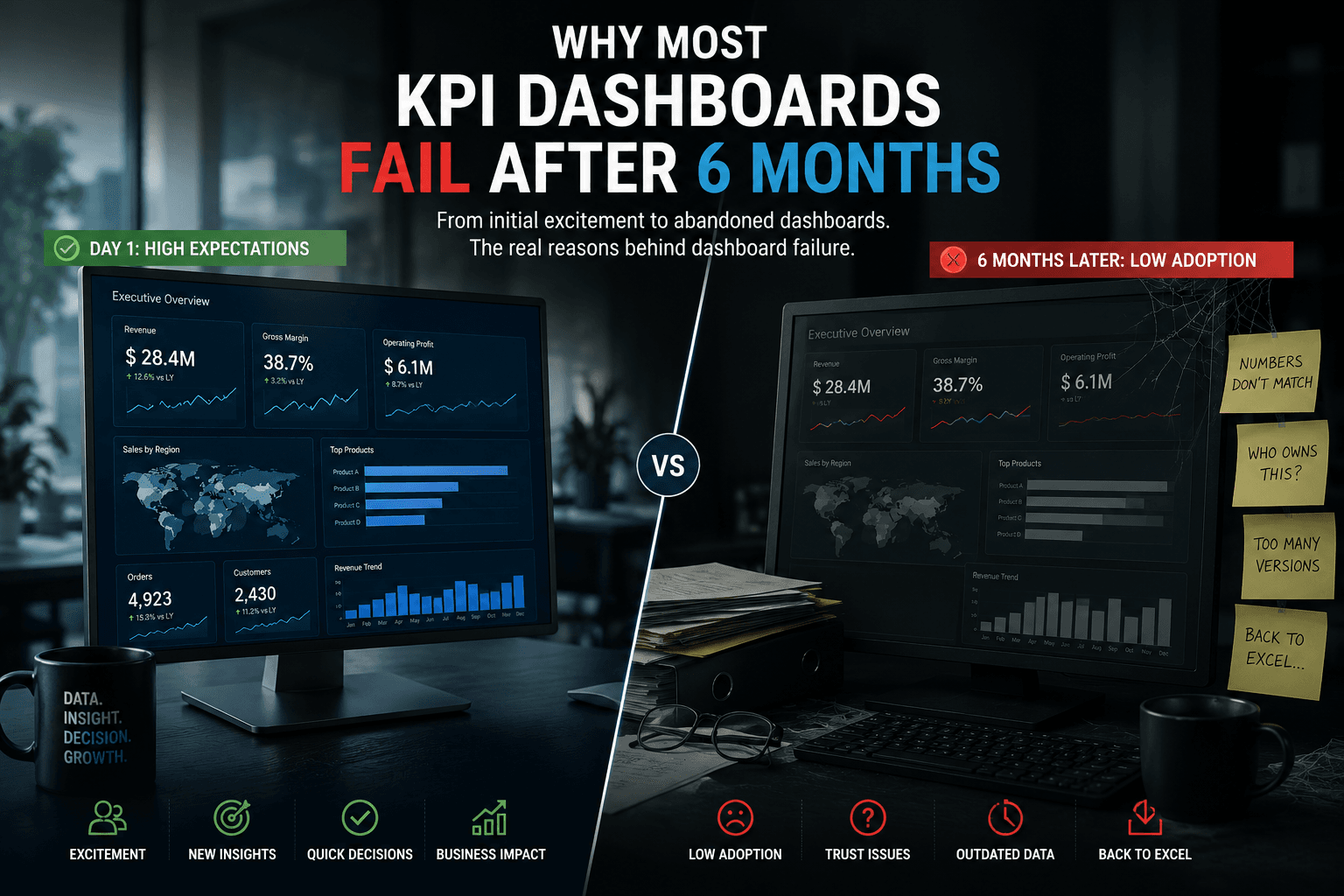
The reporting layer is important because it prevents every dashboard from becoming its own separate interpretation of the business.
When it is missing, teams often rebuild the same logic again and again in Excel, Power BI, SQL queries or local files.
When it is well designed, reports become easier to trust, maintain and scale.
What Does the Reporting Layer Contain?
A reporting layer may include:
- cleaned and transformed tables
- business dimensions
- fact tables
- semantic models
- KPI definitions
- calculation rules
- hierarchies
- security rules
- business-friendly field names
- standard filters
- documentation
It is not only a technical layer.
It is where business logic becomes reusable.
For example, instead of calculating revenue separately in ten dashboards, the reporting layer can define revenue once and make that definition available everywhere.
Why the Reporting Layer Matters
It improves KPI consistency
Different teams often calculate the same KPI differently.
Revenue, margin, order backlog, overdue amount, active customer, service level or sales performance can all have multiple interpretations.
The reporting layer makes these definitions explicit.
It helps answer:
- What is included?
- What is excluded?
- Which date is used?
- Which business rule applies?
- Who owns the definition?
This reduces confusion and improves trust.
It reduces dashboard complexity
If too much logic is built directly inside dashboards, those dashboards become hard to maintain.
A reporting layer moves reusable logic upstream.
This makes Power BI reports lighter, cleaner and easier to understand.
It supports governance
Governance is not only about access rights.
It is also about controlling meaning.
The reporting layer helps govern:
- metric definitions
- data ownership
- transformation rules
- validation logic
- security constraints
- documentation
Without governance, a BI environment grows quickly but becomes unreliable.
Reporting Layer vs Data Warehouse
A data warehouse stores and structures analytical data.
A reporting layer makes that data usable for reporting and decision-making.
They are related, but not identical.
The data warehouse may contain technical tables, historical data, raw extracts and transformed data.
The reporting layer focuses more on the business consumption of that data.
In practice, the reporting layer may be implemented through:
- data marts
- SQL views
- dbt models
- Power BI semantic models
- curated tables
- metric layers
- governed datasets
The best implementation depends on the company’s architecture, scale and governance maturity.
Reporting Layer in Power BI
In Power BI, the reporting layer often appears through the semantic model.
This model defines:
- tables
- relationships
- measures
- DAX calculations
- hierarchies
- row-level security
- business names
A strong Power BI semantic model allows multiple reports to reuse the same definitions.
A weak model forces each report developer to recreate logic manually.
This is why Power BI governance is not only a design topic. It is a data modeling topic.
Common Reporting Layer Mistakes
Building dashboards before defining metrics
Many teams start with visuals.
They design charts before agreeing on definitions.
This creates dashboards that look complete but are difficult to validate.
The right order is:
Business questions → KPI definitions → Data model → Dashboard design
Mixing technical and business fields
Business users should not need to understand every technical code in the source system.
The reporting layer should translate technical fields into business-friendly concepts.
Duplicating measures across reports
If the same KPI is calculated in multiple reports, inconsistencies will appear.
Critical metrics should be centralized and reused.
Ignoring documentation
A reporting layer without documentation becomes another black box.
Documentation should explain source fields, transformations, measures, filters and business ownership.
What a Strong Reporting Layer Looks Like
A strong reporting layer is:
- business-readable
- technically traceable
- reusable across dashboards
- governed by clear ownership
- documented
- tested against source data
- designed around decision-making
- scalable as new reports are added
It should not be overloaded with unnecessary complexity.
Its role is to make reporting logic clear and repeatable.
Example: Revenue Reporting
Imagine three teams reporting revenue.
The finance team uses invoiced revenue.
The sales team uses booked orders.
The operations team uses shipped quantities.
All three views can be valid.
The problem appears when they are all called “revenue” without explanation.
A reporting layer can define separate measures:
- booked revenue
- invoiced revenue
- shipped revenue
- net revenue
- gross revenue
Each measure has a clear calculation rule and business owner.
This does not remove complexity. It makes complexity visible.
How Datilog Helps Design Reporting Layers
Datilog helps companies build reporting layers that connect business definitions with technical implementation.
This can include:
- source-to-target mapping
- KPI workshops
- semantic model design
- Power BI model optimization
- ERP and CRM data interpretation
- Snowflake or data warehouse modeling
- reporting governance
- documentation and validation
The objective is to make reporting reliable enough for real decisions.
Final Thought
The reporting layer is one of the most important parts of a business intelligence architecture.
It is where raw data becomes business meaning.
Without it, dashboards multiply but trust decreases.
With it, BI becomes more consistent, scalable and easier to govern.
Datilog helps organizations design reporting layers that make data understandable, traceable and useful for decision-making.
Related Datilog resources
To go deeper into this topic, explore these Datilog resources:
- Data, Business Intelligence & ETL Consulting
- What Is ETL in Business Intelligence?
- Business Intelligence Pipeline: From Sources to Dashboards
- Reporting Layer in Business Intelligence
Related BI Trust Resources
If you are working on reporting reliability, these pages complete the same BI governance cluster:
- Semantic Layer vs Reporting Layer
- Why BI Reports Show Different Numbers
- Semantic Layer Glossary
- Fix Unreliable BI Reports
- BI Requirements Template
- Data, BI & ETL Consulting
A strong reporting layer is rarely just a technical table or dataset. It works best when it is connected to clear KPI definitions, a semantic model, data quality checks and a governance process that business teams understand.


